
Check out my Technorati profile.
Technorati is a cool site.Here you can submit your blog to generate traffic to your blog.Do give a visit.
Technorati Profile
Cricket Mania Headline Animator
Tuesday, June 2, 2009

Monday, June 1, 2009
Tait and Krejza earn Australia A call-up

Shaun Tait's confusing few weeks has continued with his selection in the Australia A side to take on Pakistan A in Queensland in June and July. Less than three weeks after losing his Cricket Australia contract, Tait was chosen for the limited-overs portion of the series in a squad that will be captained by Cameron White.
Bryce McGain's quick slide following his Test debut continued as the selectors turned instead to White and two other slow bowlers. Jason Krejza had fallen off the radar after his two Test appearances but is back in the mix alongside the young Victoria left-arm spinner Jon Holland.
There has also been a shift in the wicketkeeping ranks with Tasmania's Tim Paine chosen ahead of Luke Ronchi. It is less than five months since Ronchi played for Australia, yet he has now disappeared below Paine and the Ashes-bound Graham Manou as the backup glovemen to Brad Haddin.
The series begins with two four-day matches in Townsville before heading to Brisbane's Allan Border Field for a Twenty20 and three one-dayers. Tait, Moises Henriques and David Warner have been included only for the shorter games while Ryan Broad, Michael Klinger and Burt Cockley have been picked as specialists in the longer version.
The pace attack for the four-day matches will be made up of the emerging Cockley and Clint McKay, alongside the established Doug Bollinger and Brett Geeves. The vice-captain Adam Voges, 29, is the oldest member of the group and the chairman of selectors Andrew Hilditch said it was a deliberate decision to choose a youthful squad with the one-day focus already on the 2011 World Cup.
"The National Selection Panel has, with view to the future of Australian cricket, selected a very young squad to play both the four-day and one-day games," Hilditch said. "The selection recognises the performances of these young talented players in the domestic season last year whilst concentrating on those players we have identified as having the ability to play a significant role in the development of Australian cricket in the future."
Australia A squad Cameron White (capt), Adam Voges, George Bailey, Doug Bollinger, Ryan Broad, Burt Cockley, Callum Ferguson, Brett Geeves, Moises Henriques, Jon Holland, Michael Klinger, Jason Krejza, Shaun Marsh, Clint McKay, Tim Paine, Shaun Tait, David Warner.
Why Australia, Sri Lanka and West Indies are in one group
How the groups were made
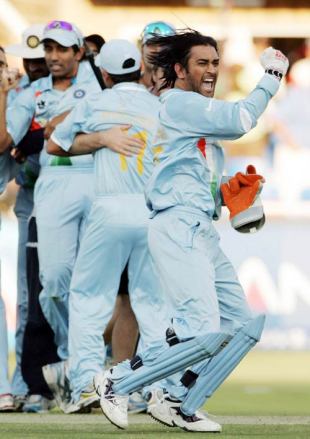
The 12 teams competing in this year's World Twenty20 are the nine Full-Member countries and three Associates who made it to England through the qualifying tournament, which was held in Belfast. They have been divided into four groups of three each based on their seeding, which depended on their standings in the inaugural World Twenty20 in 2007 (for the teams that took part in it). Since India were champions they were seeded first, their opponents in the final, Pakistan, were ranked second, while the losing semi-finalists Australia and New Zealand were seeded third and fourth. The top four seeds were then put in four different groups for this year's tournament.
The best among the rest, South Africa, were seeded fifth and put in the same group, D, as the team seeded fourth -New Zealand - while Sri Lanka and England, the 6th and 7th seed, were placed in groups C and B. Had West Indies at least finished eighth in 2007, there would not have been a 'group of death' this year. But they did not even win a single game, losing to Bangladesh because of an inspired innings from Mohammad Ashraful, and were seeded 11 and placed in Group C. Bangladesh, who qualified for the Super Eights in 2007 but didn't win a game in that round, were eighth and put in India's group.
Group A - India (1), Bangladesh (8), Ireland (9) Group B - Pakistan (2), England (7). Netherlands (10) Group C - Australia (3), Sri Lanka (6) West Indies (11) Group D - New Zealand (4), South Africa (5), Scotland (12)
Each team will play the other in its group during the preliminary round and the top two will qualify for the Super Eights. What this means is that either Bangladesh or Ireland, or both, are assured of a place in the second stage, while one of Australia, Sri Lanka and West Indies will crash out after round one, leading to the possibility of another group of death in the next World Twenty20, in the Caribbean in 2010.
If two teams in a group have equal points at the end of the first round, the one with more wins will be placed higher. If they have equal points and the same number of wins, a likely scenario, then the team with the higher net run-rate will be ranked higher. Should net run-rate also fail to separate the sides, then the one with the higher number of wickets taken per balls bowled in the group stage in which results were achieved, will be preferred. And if the teams remain in a deadlock, then the winner of the group match between the sides will prevail. If all of the aforementioned tie-breakers fail, the teams will be separated by drawing lots.
And should the weather in England wreck all the three matches of a particular group, the top two seeded teams in the group will progress. No points, however, will be carried forward from the group stage into the Super Eights.
The Super Eights
The teams in the Super Eight will be designated as A1, A2, B1, B2, C1 C2, D1, D2 depending on which group they qualified from. If the top two seeds from a group qualify, they will be seeded 1 and 2 respectively for the Super Eight regardless of which team actually finished first and second in a group during the first round. For example, if Bangladesh are first and India are second in Group A, Bangladesh will still be A2 while India will remain A1 for the Super Eight because India were seeded 1 while Bangladesh were 8. However, if the third seeded team in the group knocks out a higher seed, it will take the place of the knocked-out opponent. For example, if Bangladesh and Ireland qualify from Group A, then Ireland will be A1 for the Super Eight stage. If India and Ireland qualify, then Ireland will be A2.
During the Super Eight, the teams will be split into two groups of four - A1, B2, C1 and D2 are in the first group, while A2, B1, C2 and D1 are in the second. Each team will play the others in its pool with the top two from each group qualifying for the semi-finals. If teams are tied on points in a Super Eight group then the same parameters which were used to break a tie in the preliminary stage will be used, the difference being that only the Super Eight matches will be taken into consideration for most wins, net run-rate etc.
If all of the matches of a Super Eight group are ruined by rain, the teams will be ranked on basis of most points, most wins, net run-rate during the group stage and the top two will go through. If the teams still cannot be separated the semi-finalists will be picked based on the original seeding for the tournament.
A one-over eliminator, or Super Over, will be used to break a tie in a semi-final, if one should occur. However, if weather prevents the Super Over from taking place after a tie, the team which progresses to the final will be determined by looking at who has the most wins, better net run-rate, higher number of wickets per balls, the only difference being that this time both group and Super Eight matches will be taken into consideration.
The final, however, has no such provisions. If the final is tied, the match will be decided by a one-over eliminator. If the eliminator cannot take place because of bad weather, then the two finalists will be declared joint winners.
Collingwood calls for 'brave' campaign

England captains have been two-a-penny in the past few months, but if Paul Collingwood looked a little nervous as he faced the media on the eve of his return to the role, it was not because he has taken over a sinking ship in the manner of his immediate predecessors, Andrew Strauss and Kevin Pietersen. Quite the opposite in fact.
For the first time in a long time, England have rediscovered that winning habit, and as the Ashes begin to loom, so too does the invidious nature of Collingwood's three-week tenancy. On his watch, England's precious momentum could conceivably be boosted by a glorious maiden triumph in a major global event. More likely, however, it stands to be dented by another ignominious failure to match the skills and chutzpah of the more established limited-overs nations.
Collingwood was at the helm in South Africa two years ago, when England's only victory in five attempts came against the underdogs of Zimbabwe. With Andrew Strauss stepping aside to let his harder-hitting colleagues take centre stage, Colly's back in the hot seat, and to judge by these early impressions, he's finding it hard to inject his words with the right measure of confidence.
"We've got to be brave to win a tournament like this," Collingwood told reporters at Lord's. "We have to have the belief that we can win as a team, but we also have to have belief in our own ability in the middle. Twenty20 cricket is not an exact science, so you have to think on your feet in the middle. Sometimes it only takes one person, and we've got a lot of matchwinners, so I really do believe we can surprise a few people. I'm not going to say we are going to win it, but we have to believe we can win it."
Ever since England's near-miss at the 1992 World Cup, their one-day cricket has struggled to cope with the national preference for the five-day version, and in this summer of all summers the disparity seems even more stark than ever - no other national captain, for instance, would have to field questions on the eve of such a prestigious competition about a star player's fitness for a still-distant Test series - as Collingwood did of Andrew Flintoff.
"Freddie is a world-class player, simple as that," said Collingwood. "He'll be coming back into the England side, and he'll be welcomed back because we'll need him 100% come the Ashes. But right now we're concentrating on a major World Cup tournament. If we go all the way and win it, it's certainly going to give us some major confidence, but this is a one-off. The Ashes is something we've been building up to for a long time now. The next three weeks shouldn't affect the way we approach that."
It shouldn't affect anything … but as Collingwood's demeanour suggested, it just might. "A lot of our momentum comes from results, because when you're winning things are very easy," he said. "It's [difficult] when the losses come along, and we will have losses in this kind of tournament, that's the nature of Twenty20 cricket. But what we've got is a strong team ethos, and it's not just me that has to drive that, we'll have to filter that team ethos through to the new guys. They know what is expected of them and the England team."
For the second time in two Twenty20 tournaments, England's clutch of new boys could make the difference between success and failure. In 2007, the selectors took a punt on the likes of Darren Maddy, Jeremy Snape, Chris Schofield and James Kirtley - men who had performed with aplomb in the domestic Twenty20 Cup, but who, to a greater or lesser degree, had been found out at the highest level. Sure enough, the experiment failed.
This time, however, Collingwood has far more faith in the men at his disposal. Of the two uncapped members of the original squad, one - Graham Napier - has just returned from an educational stint with the IPL, while the other - Eoin Morgan - justified his call-up with an exceptionally inventive innings of 161 for Middlesex at Kent in the Friends Provident Trophy earlier this month. Despite the innate fatalism that tends to accompany English one-day campaigns, there are genuine reasons why the story could be different this time.
"You look at Ravi Bopara at the top of the order, he's going to be crucial for us, and Stuart Broad and Jimmy Anderson have developed as bowlers," said Collingwood. "We have players who are in crucial positions who have gained a lot of international experience since 2007 and I think they're better players now.
"There are obviously concerns when you meet up as a team that the new guys will not be brought into the side as well as they could be," he said. "This time around that isn't a concern, because I think we have a really strong culture in the side, and the guys get on really well. The boys have got the skills and are very confident, and we just want to take that out into the middle."
Whether the brave talk translates into brave deeds, however, remains to be seen. A fear-free Dutch team, bolstered by the IPL star Dirk Nannes and Essex's uncompromising allrounder, Ryan ten Doeschate, await in the tournament opener, and then it's over to Pakistan, beaten finalists in 2007, and a side who are just glad to be back on the international stage after the horrors of Lahore.
"Playing at home could be an added pressure but we're not taking it like that," said Collingwood. "We've got an advantage in many ways, we know what the wickets are all about here, and we're very excited about playing in front of our own crowds. No England cricket team has won an ICC tournament before so we have a three-week period here for us as a team to hopefully put that right."
Our main goal is to reach the Super Eights - Ashraful

Mohammad Ashraful has said Bangladesh's main objective is to qualify for the Super Eights of the World Twenty20 which begins on June 5. They play their first game on June 6 against India, the current champions, whom they famously beat in the 2007 World Cup.
"In this form of the game any side can beat the other," Ashraful told reporters at Lord's. "We defeated the West Indies in the last World T20 in South Africa and progressed to the Super Eight. Our main goal is to repeat that and if we beat India, who are the world champions, in the first match then we will fancy our chances of doing well against the top sides and making the semi-finals even."
Barring the upset win over West Indies in the last World Twenty20, Bangladesh had a disappointing tournament, losing their other four games by fairly convincing margins. However, Ashraful, who had a poor run himself, averaging 17.40 in five games, was confident of putting up a better show this time. "We have come here one week early, had three games against New Zealand, Holland and Scotland and the boys have done well," he said. "We are confident and there are two tough games against Australia tomorrow and Sri Lanka the day after. So that's a nice build-up to the main tournament."
One of the Bangladesh players who has impressed in the warm-ups has been the seamer, Rubel Hossain. He returned figures of 4 for 19 against Holland, and 5 for 16 against Scotland. "He has taken nine wickets in two matches and is bowling really well. He has an awkward action and has bit of extra pace," Ashraful said of Rubel.
He also backed his deputy Mashrafe Mortaza to come good after a disappointing solitary game in the IPL, where he conceded 58 runs in four overs for Kolkata Knight Riders, including 27 in the decisive final over of the contest. "It was only in the last over that he did badly. Otherwise I thought he was okay. But I know he'll be back. He is that type of a player. He always does well against India."
Ireland is the other team that Bangladesh must face in the group stage, and having lost to them at the 2007 World Cup they might have reason to be cautious. But Ashfraful was confident of averting a repeat. "I think if we play our best cricket then we should not have a problem against Ireland because we have more quality in the side."
We have "moved on" after Lahore - Sangakkara
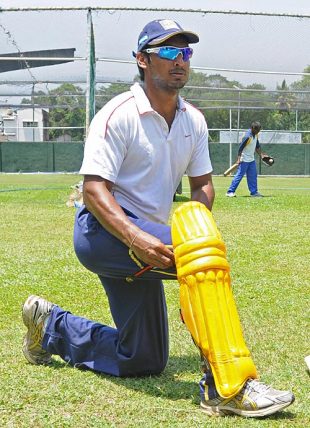
kumar Sangakkara, the Sri Lankan captain, believes his team is now mentally prepared to return to international cricket following the Lahore bus attack on March 3, but admitted that some apprehensions still remain, as shown by the recent decision to withdraw - along with Muttiah Muralitharan and manager Brendon Kuruppu - from a speaking engagement in Oxford due to security fears.
"Returning to cricket is the sign of normalcy for us, getting back to our normal lives," Sangakkara told Cricinfo. "The guys have moved on very well from Lahore. It is great to be back playing cricket and hope we can make a challenge in the World Twenty20. The side is really looking forward to doing well."
Sangakkara was one of the seven players injured in the attacks after terrorists fired and hurled grenades at the Sri Lankan team bus as it made its way to the Gadaffi Stadium on the third day of the second Test against Pakistan.
The team had its first practice nets at Lord's on Saturday afternoon and the players seemed happy to be back in action. "We remember the Lahore attack. There is a lot of emotion tied up with it, but we've got to move on," Sangakkara said. "Life moves on, cricket goes on. The guys have realised that and they are prepared mentally now."
Even if Sangakkara was happy with the security arrangements put in place by the ICC for the event, the aftermath of Sri Lanka's victory over the Liberation Tigers of Tamil Eelam (LTTE) - which brought to an end to a 26-year-old civil war - has brought with it new concerns.
Sangakkara said they had been alerted to the perceived security risks and players had been asked to keep the management informed of their movements. On Friday, he and Muralitharan were supposed to take part in a debate organised by the Oxford University Union but the visit was cancelled at the last minute as the organisers failed to put the required security arrangements in place.
"Our movements are a bit restricted at the moment but the security people have allowed us to keep our focus on the game," Sangakkara said.
Asked what the mood was like before the team boarded the bus for the first time after Lahore, Sangakkara said it was full of optimism and the usual banter. "Getting back together, going on a bus you know sometimes you look around and you feel how vulnerable you are in the bus if anyone wants to do any harm. At the same time it is great to get back on it as a team and play your first major tournament after Lahore. That feeling of togetherness, being through tough situations, and playing the game we love brings us a lot closer together."
Cricketers love routines and are superstitious when it comes to matters such as sitting on a particular seat. The Sri Lankans are no different. "Everyone just fell into their places. Lots of players have seats they are really fond of: Sanath [Jayasuriya] always sits on the right three to four rows from the front and Mahela [Jayawardene] likes to sit at the back. So the guys are back in their usual positions. Life is back to normal."
| Lots of players have seats they are really fond of: Sanath [Jayasuriya] always sits on the right three to four rows from the front and Mahela [Jayawardene] likes to sit at the back. So the guys are back in their usual positions | |||
Quite a few of the players, including Sangakkara, Muralitharan, Jayawardene, Jayasuriya, Tillakaratne Dilshan, Lasith Malinga and Farveez Maharoof played during the IPL in South Africa and are expected to carry the momentum into England. "We are trying to play on our unpredictability and our unorthodox make-up and hopefully be able to come up with the unexpected and surprising," Sangakkara said.
Unlike teams like India and Pakistan, who have landed relatively easy groups, Sri Lanka are paired with Australia and West Indies. Sangakkara is aware of the threat but is confident his team can make the second round as long as the batsmen can construct formidable scores for his in-form bowlers to defend.
"We start off in a very tough group so we need to win at least one, if not both of our opening games," he said. "We have got probably one of the best bowling attacks, but we've just got to make sure our batting complements that and gets totals we can defend. Guys like Jayasuriya, Dilshan and Mahela are in good form and can win games on their own, so it is going to be a good experience. It is also a good way to judge how far we need to go before becoming a force in Twenty20 cricket. We've got the depth in both bowling and batting."
Sangakkara has also put the onus on his young allrounders Maharoof and Angelo Mathews to perform and make an impact in the lower-middle order, which Sangakkara feels is the team's Achilles heel. "Angelo Mathews and Farveez Maharoof will have to take that responsibility of making that difference," he said. "We have lot more strengths than weaknesses."
Smith aims to overcome World Cup hurdle

South African sports fans are spoilt for choice at the moment. No sooner has the IPL finished than the British and Irish Lions have started their tour and now their cricket team is in England preparing for the ICC World Twenty20. Such is South Africa's passion for rugby the progress of Graeme Smith's side over the next three weeks may struggle to grab the attention. But they have the chance to cap off a period where they have caused some significant shifts in the world order.
They are now the No. 1 team in one-day cricket after taking that crown off Australia and also pushed them close for the top spot in Tests. With a host of their players having experienced the IPL first hand, they are primed to challenge in the ICC World Twenty20. But South Africa have a history of stalling on the big stage. Their continued success over the last year has helped loosen the chokers tag, yet it will linger until they conquer their World Cup problems.
"It would be lovely if we could be successful in this tournament or any ICC tournament that is coming up," Smith said. "We have had an incredible period in the last 16 months and the team has achieved so much. The confidence is good and we are excited about playing this tournament with the chance to go out and express ourselves. I think there is a lot more talent, flair and confidence among this team than ever before."
South Africa's preparations didn't get off to the best start when they arrived at Southgate, in north London, only to find they were not expected for a training session and had to relocate to Lord's. Smith said he would raise a few issues with the technical committee, but added that the way the team responded shows how focussed they are. "Even today with the not-so-great training facilities we have had all over the place the guys have still applied themselves. There's a good, mature attitude among the squad."
And Smith hopes the IPL experience will benefit his team, especially as a number of players were senior figures with their franchises. "A lot of our players had prominent roles in a number of the teams, which probably wouldn't have happened if it had been in India, and they had good leadership roles among their teams."
During the first World Twenty20 two years ago, in South Africa, one of the most controversial selections by the hosts was to omit allrounder Jacques Kallis. This year he is part of the squad and comes off the back of a useful spell at the IPL where he made 361 runs at 27.76 for Royal Challengers Bangalore.
"Jacques is the one player who arrives here with a point to prove," Smith said. "He had a decent performance in the IPL so is confidence his high and tactically how we use him is important. He's an allrounder and needs to contribute in all forms."
However, Smith himself didn't enjoy as productive a tournament managing 212 runs at 19.27 in his 12 matches for Rajasthan Royals. But he has masses of Twenty20 experience to fall back on including captaining Somerset to the English Twenty20 Cup title in 2005, winning the Pro20 with the Cape Cobras and last year's success with Rajasthan in the inaugural IPL.
"I have a few really good ideas on how to play the game," he said. "The experience as captain plays a key role and I think I have a good grip on the game."
This tournament is the final point in a marathon spell of cricket for the team which has included last year's trips to India and England, back-to-back series against Australia, plus six weeks at the IPL for many of its players, and Smith has called for one last effort from his squad.
"It's been a lengthy period and mental fatigue is probably our biggest challenge and something we have addressed as a team," he said. "Something that we've been really good on is responsibility and professionalism throughout this period. At different times you feel a little jaded, but I think we can find it within us to pick ourselves up for three more weeks."
Subscribe to:
Posts (Atom)

