Cricinfo Latest Photos

Cricket Mania Headline Animator

Showing posts with label International. Show all posts

Wednesday, June 3, 2009

Wright and Bopara crush West Indies


England have comfortably had the better of West Indies throughout their early-season exchanges and the theme continued at Lord's. They raced to a nine-wicket win with 32 balls remaining on the back of an electric opening stand of 119 between Luke Wright and Ravi Bopara. Wright finished with 75 from 38 deliveries after giving the stands a peppering, and confirming his position for the tournament opener, against Netherlands, on Friday.

England's opening combination has never been settled in Twenty20s, but after this effort it's difficult to see these two being separated in the next couple of weeks. The team performance against Scotland was far from convincing, but here England hit their stride with the bowlers and fielders also doing their jobs to hold West Indies to 144.

As the openers did against Scotland they played themselves in for a couple of overs, but the difference was this time they kicked on. Wright struggled initially and the pressure was building, but he found his range as he tucked into Lionel Baker, then Bopara opened up as he took four crunching boundaries off Dwayne Bravo's opening over.

West Indies' fielding again let them down when Sulieman Benn dropped a regulation chance at midwicket when Bopara was on 29 and the match was soon out of reach. England are often criticised for not clearing the boundary often enough, but Wright unleashed three consecutive leg-side sixes in Kieron Pollard's first over which cost 22 with a show of brutal strength and moved to fifty off 36 balls. It was the style of batting that he produces at county level but hasn't been consistently able to translate to the next level. He won't always be successful, but the England management appear ready to trust his ability.

Bopara's talent is already clear and some of his boundary-striking was a joy as he played with uninhibited ease. His half century took 31 deliveries and it was looking as though England would cross the winning line without loss until Bopara picked out deep midwicket against Shivnarine Chanderpaul's occasional spinners.

Wright hurried the game to a conclusion in style as he crunched Chanderpaul for another six and showed that he could hit proper pace as well by creaming Fidel Edwards down the ground. It was a highly satisfactory outing throughout by England, who were also sharp in the field and consistent with the ball.

Chris Gayle handed the captaincy to Denesh Ramdin and didn't bother to bat despite being named in the 13 and West Indies struggled for any real momentum. Only Ramnaresh Sarwan's unbeaten 46 from No. 6 lifted them over 140 as England fielded their three main quicks, with Stuart Broad the most economical as he went through his variations, and Adil Rashid conceding just five-an-over during his four overs.

The only blot on England's evening was the opening-over drop by Graeme Swann at second slip that reprieved Xavier Marshall. West Indies' opening partnership was beginning to increase the tempo, with Andre Fletcher launching James Anderson over mid-off for six, before the first horrendous misunderstanding left Fletcher stranded as he tried to come back for a second.

Fletcher's wicket came in an over that encapsulated Twenty20 cricket with 16 runs being traded for two wickets. Two balls later Chanderpaul was brilliantly held at third man by Ryan Sidebottom, who sprinted around to hold the top-edged pull, and showed that his fitness concerns are well behind him. West Indies didn't help themselves with some of their running when Pollard was the second to fall to poor calling as he sprinted up the pitch only to find Marshall hadn't moved an inch.

Rashid was given a bowl ahead of Swann, while Wright was also handed his turn and provided the next breakthrough when Marshall gloved his pull to James Foster. Rashid had looked understandably nervous against Scotland, but after a big first ball wide was more settled in this innings. Helped by the fact West Indies had lost wickets he conceded just a single boundary in his four overs and picked up Bravo who carved down to long-off.

Lendl Simmons should have gone when he had 3 but Asoka de Silva failed to pick up the outside edge off Broad, however he could only add four more before picking out deep-square leg against Swann. Sarwan ran hard towards the end of the innings, but boundaries were difficult to come by throughout the innings. That wasn't a problem England experienced.

India sound ominous warning


The world champions of the Twenty20 format made an emphatic statement against their fellow finalists from 2007, brushing aside Pakistan by nine wickets at The Oval. In an ominous sign for the competition, India were not at their strongest - Virender Sehwag and Zaheer Khan are still carrying shoulder injuries - yet still produced an imperious performance before a raucous south London crowd.

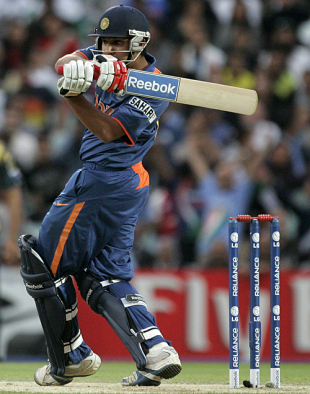
Rohit Sharma slotted so seamlessly into the opener's role that India might be tempted to continue with him at the top even when Sehwag returns to the side. Rohit had success opening against New Zealand as well, smacking 36 off 20 balls, and on Wednseday he managed one better, staying the distance with a match-winning 53-ball 80.

Rohit has taken to the role of opener with relish, however the captain, MS Dhoni, remained non-committal as to whether he would be retained at the top of the order when Sehwag makes his return.

"Frankly speaking I don't know [whether Sehwag will bat in the middle]," Dhoni said. "I think it's always better to have a problem of plenty than having nobody to fill in the space. It's good to have Rohit Sharma in form. As of now I don't know what will happen when it comes to the batting order."

Rohit was a key member in Deccan Chargers' triumphant IPL campaign, and was one of that tournament's most consistent performers. But unlike in England, where he is being relied upon to lead the Indian innings, Rohit earned the reputation as one of the IPL's better finishers, coming in at No. 5 for Deccan to accelerate scoring rates and polish off a run-chases. His versatility was on show on Wednesday, displaying both poise and power as he pierced gaps in the infield while seldom risking the airborne route.

"We discussed it with him [Rohit] during the practice sessions and he was quite keen," Dhoni said of the decision to elevate Rohit in the batting order. "When you ask a guy, you always watch for his response, how quick it is and whether he has thought twice about it or not. Rohit was very keen on opening and with Viru [Sehwag] injured, he was the best option available. Rohit always has time, even when he plays quickest bowlers he has got the time and talent. Gary also played a part in the decision."

Rohit's innings, and Gambhir's supporting half-century, denied the match of an exciting finish that would have done justice to the feverish atmosphere at The Oval. The ICC wanted everyone to 'Catch the Spirit' and it was impossible not to. Celebrations were adrenalin-filled and every ball - be it dot, six or out - was cheered by an emotionally-charged full house, evenly divided in support between the teams. This was more than a warm-up game.

The players felt the same way, with India shelving all thoughts of experimentation. Dhoni said the bowlers had attempted a back-of-a-length approach in the previous game but merely tried to stick to basics today. "We were not experimenting," Dhoni said. "An India-Pakistan game, even though it's a warm-up, is a tough game to play. We were looking to do the basics, bowl yorkers."

One bowler who wasn't looking to bowl yorkers was Ishant Sharma, and he turned the game India's way. Pakistan had raced to 45 after four overs when Ishant came on and completed a rare double-wicket maiden, which included a run-out, to wrestle back the momentum. Ishant bowled the fifth, 14th and 17th overs and finished with 3 for 11. Dhoni said that he was looking to use Ishant during the middle overs, when he could bowl to his strengths.

"It's about how you want to use him. More often than not he has been used with the new ball while the field restrictions are on and later on in the slog," Dhoni said. "I feel it's important to use him in the middle overs when batsmen are not really looking to go after the bowlers, so he doesn't have to bowl those yorkers. He can then bowl to his strengths; he's the kind of bowler who likes to hit the deck hard."

Twenty20 victory margins are rarely more emphatic than nine wickets and 18 balls to spare and Dhoni said that it would be "tough to replicate the performance". Perhaps it was fitting, though, for he felt that today's crowd at The Oval would also be the best the tournament gets.

More than just a warm-up


Charity matches are normally about being nice, but if that theory was ever to be tested, it was when India clashed with Pakistan on Wednesday.

History and emotions run deep in contests between the two nations; sentiments that intensified further after India's last-over victory over Pakistan in the inaugural ICC World Twenty20 two years ago. Indeed, the tournament director, Steve Elworthy, placed the "warm-up" match into perspective when he told Cricinfo prior to play: "This is the biggest game in the tournament." There is nothing quaint about matches between the Asian neighbours.

Pakistan coach Inthikab Alam suggested as much during the week when, with an inscrutable smile, he responded to a question about whether both teams would treat the contest more seriously than a centre-wicket practice. "Even if it is a practice game both sides will take it seriously," he said, "That has always been the case." Nothing betrayed that sentiment on Wednesday.

With tensions between India and Pakistan still inflamed in the wake of the 26/11 terrorist strikes in Mumbai last year, it seems unlikely the two teams will meet in the near future outside of ICC events. Given the prevailing political climate, this warm-up game was immensely significant.

The crowds came in big numbers, the players displayed their usual aggro, the Oval swayed back and forth as the Indian and Pakistan fans drummed up support for their respective teams. The most important element in any Indo-Pak tussle is the crowd: take them out and the oval becomes an arid zone. And when the fans started to pour into the Kennington complex four hours before the schedule start, another intense affair seemed assured. Not even the unseasonably cold weather could deter them.

MS Dhoni and co. had been asked throughout IPL2 - relocated to South Africa at the eleventh hour - if they had been missing the throbbing crowds which filled stadia across India during the first edition of the tournament. The answer, emphatically, was yes. But for three hours on Wednesday, Kennington's oval resembled Kolkata's gardens, and the match was played with all the passion and fervour of a true local contest. A homecoming of sorts.

Anticipating the enormity of the event, tournament organisers left little to chance. "The people in charge of security had already briefed us that they had beefed up the security ahead of such a big game," Elworthy said. Still, with relations between the cricketing nations deteriorating of late, emotions were always likely to fray, and scuffles and evictions were witnessed in at least three sections of the ground. These, however, did not spoil the over all atmosphere, which some supporters described as being "like a jalsa" (festive).

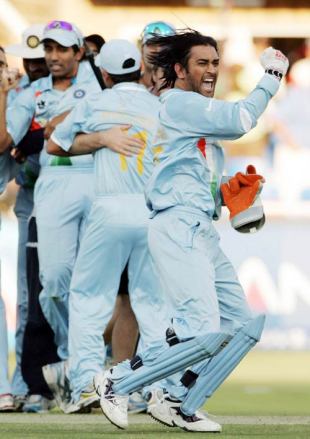
From the moment Praveen Kumar unleashed his first delivery of the match, The Oval reverberated with the chants of "Indiaaaaa, Indiaaaa". And when the athletic and proactive Suresh Raina ran out the dangerous Kamran Akmal, the decibel levels increased ten-fold, particularly after Raina's extravagant celebration, in which he galloped towards the dugout as if he had won an Olympic medal.

Critics have suggested India and Pakistan matches are scheduled too frequently, and thus have become devalued in the public eye. Not on the evidence of Wednesday. "It always has such an intensity," Dhoni said of his side's rivalry with Pakistan. "This was expected, a big crowd. This will be the best crowd you will get a tournament. We played New Zealand in front of hardly any crowds. It helps us to give your best."

Amidst the party-like atmosphere - the air was full of bubbling excitement - the fans did not neglect to show their appreciation for good cricket: the Indians fans acknowledged the brilliant efforts of Ahmed Shehzad who ran backwards to hold on to a brilliant catch and cut short Rohit Sharma's stunning innings on 80.

"Shrunk format has expanded cricket's boundaries," read a placard, held by an Indian fan in the Jack Hobbs stand. On the evidence of Wednesday, it also crossed borders.

NZC opens door for Bond comeback


Shane Bond's potential international comeback remains on track following New Zealand Cricket's (NZC) decision that former ICL players will be eligible for national selection. Players including Bond, Daryl Tuffey and Lou Vincent need only prove they have severed all ties with the unofficial ICL and they will be immediately available for New Zealand selection.

The NZC announcement came after a board meeting on Thursday and opens the door for the players to be selected for New Zealand's next international engagement, a tour of Sri Lanka in August. Bond and Tuffey, both of whom performed strongly in the recent New Zealand domestic season, would be the most likely candidates for a recall.

"We understand both of these players wish to return to international cricket, which is great news for cricket in New Zealand," Justin Vaughan, the NZC chief executive, said. However, he said the board's decision was "about policy rather than any player's particular circumstance".

"Today's decision is by no means a guarantee of selection for any player," Vaughan said. "All former ICL players would need to earn their way back into the national side on merit.

"There's no question that New Zealand suffered heavily from the ICL - our national side lost a significant number of top players. New Zealand wants to have a top-ranked national team and this is very hard when you are unable to select from all your best players."

Tuffey has reportedly already severed ties with the ICL, with Bond and Vincent likely to follow suit. Other New Zealand players who took part in the most recent ICL tournament included Hamish Marshall, Andre Adams, Chris Harris and the retired Craig McMillan and Nathan Astle.

Rohit and Gambhir script emphatic win


Finally India and Pakistan played out a one-sided Twenty20 game. Filling in for Virender Sehwag as opener, Rohit Sharma continued to give India a combination dilemma and made the chase seem like an afternoon walk in a London park. A target of 159, with extra bowlers available by the virtue of this being a 13-a-side game, was by no means an easy one, but Gautam Gambhir and Rohit managed with the ease that belies the tension an India-Pakistan match brings.

Nothing about this encounter suggested it was a warm-up game. The sell-out crowd, and the intensity in the first innings was something even the final of the actual tournament will be proud of. But in the second innings, Pakistan went into the experiment mode. They went in with an interesting strategy, interchanging the usual roles between Umar Gul and Sohail Tanvir. Gul, who usually bowls in the last 10 overs, opened the bowling, and Tanvir came on to bowl in the 10th over - none of the moves worked.

Nothing about Rohit's innings suggested that he was a makeshift opener. Although Gambhir kickstarted things with three boundaries in the first three overs, including one off Gul's first ball, it was Rohit who took the match away from Pakistan. He got going with a heave over mid-on in the third over, but the slogs were conspicuous by absence in the rest of his innings.

Yasir Arafat, who bowled three overs at the top of the innings, went for a six in his second and two boundaries in his third. The 17-year-old prodigy Mohammad Aamer produced good pace in his first over, but he too was pulled for four by Rohit. By the end of the seventh over, when Pakistan threw the final roll of the dice - the spinners - India had already reached 65.

The batsmen played out Saeed Ajmal's first over quietly, but in Shahid Afridi's first over Gautam Gambhir joined the party, with a short-arm-pull over midwicket. Tanvir, in his first over, was hit for perhaps the shot of the day, a yorker flicked to fine leg. By the time captain Younis Khan called the spinners back, Rohit was in the mood for some fun, hitting Ajmal inside-out and pulling Afridi over midwicket. When he got out for a 53-ball 80, India needed only 19 runs in four overs.

Lack of discipline and a few big hits from MS Dhoni and Gambhir meant the game ended in the next over. Quite fittingly, Pakistan finished the match with a wide.

It wasn't as facile when the old sparring partners started off for the first time since last year's Asia Cup in Karachi. They wasted little time in going for punches and counter-punches during a frenetically-paced first innings. A wicket in the first over didn't deter Ahmed Shehzad and Kamran Akmal from counterattacking spectacularly with a 25-ball 43-run stand. They stumbled just as sensationally, losing the next three wickets on the same score before the two coolest heads in the team, Younis and Misbah-ul-Haq, rebuilt and took Pakistan to what seemed a fighting total.

Praveen Kumar and Shehzad set the agenda early. Praveen followed two bouncers with an outswinger to clean up Shahzaib Hasan. Akmal then crashed the first ball after the wicket through the covers for four. In the next over, Shehzad hit RP Singh for three boundaries, an over during which he was also dropped by Harbhajan Singh at short midwicket.

Dhoni quickly called on the raw pace of Ishant Sharma and the effect was immediate. First Suresh Raina ran out Akmal through superb work at cover, and Shehzad top-edged a pull in the same over. The panic set in when a promoted Shahid Afridi went boom first ball he faced from Irfan and managed just an outside edge to Dhoni - 45 for 1 had become 45 for 4.

Shoaib Malik counterattacked, but fell soon. Either side of Malik's dismissal, no boundary was hit for 42 balls until Misbah made room and lofted Ojha to wide long-on in the 13th over. By the time Younis fell for a run-a-ball 32, the two had been added 50 in 45 balls. Arafat and Misbah provided the final impetus, scoring 29 in the last two overs, but it proved to be way below-par on the night.

Monday, June 1, 2009

Why Australia, Sri Lanka and West Indies are in one group


How the groups were made

The 12 teams competing in this year's World Twenty20 are the nine Full-Member countries and three Associates who made it to England through the qualifying tournament, which was held in Belfast. They have been divided into four groups of three each based on their seeding, which depended on their standings in the inaugural World Twenty20 in 2007 (for the teams that took part in it). Since India were champions they were seeded first, their opponents in the final, Pakistan, were ranked second, while the losing semi-finalists Australia and New Zealand were seeded third and fourth. The top four seeds were then put in four different groups for this year's tournament.

The best among the rest, South Africa, were seeded fifth and put in the same group, D, as the team seeded fourth -New Zealand - while Sri Lanka and England, the 6th and 7th seed, were placed in groups C and B. Had West Indies at least finished eighth in 2007, there would not have been a 'group of death' this year. But they did not even win a single game, losing to Bangladesh because of an inspired innings from Mohammad Ashraful, and were seeded 11 and placed in Group C. Bangladesh, who qualified for the Super Eights in 2007 but didn't win a game in that round, were eighth and put in India's group.

Group A - India (1), Bangladesh (8), Ireland (9) Group B - Pakistan (2), England (7). Netherlands (10) Group C - Australia (3), Sri Lanka (6) West Indies (11) Group D - New Zealand (4), South Africa (5), Scotland (12)

Each team will play the other in its group during the preliminary round and the top two will qualify for the Super Eights. What this means is that either Bangladesh or Ireland, or both, are assured of a place in the second stage, while one of Australia, Sri Lanka and West Indies will crash out after round one, leading to the possibility of another group of death in the next World Twenty20, in the Caribbean in 2010.

If two teams in a group have equal points at the end of the first round, the one with more wins will be placed higher. If they have equal points and the same number of wins, a likely scenario, then the team with the higher net run-rate will be ranked higher. Should net run-rate also fail to separate the sides, then the one with the higher number of wickets taken per balls bowled in the group stage in which results were achieved, will be preferred. And if the teams remain in a deadlock, then the winner of the group match between the sides will prevail. If all of the aforementioned tie-breakers fail, the teams will be separated by drawing lots.

And should the weather in England wreck all the three matches of a particular group, the top two seeded teams in the group will progress. No points, however, will be carried forward from the group stage into the Super Eights.

The Super Eights

The teams in the Super Eight will be designated as A1, A2, B1, B2, C1 C2, D1, D2 depending on which group they qualified from. If the top two seeds from a group qualify, they will be seeded 1 and 2 respectively for the Super Eight regardless of which team actually finished first and second in a group during the first round. For example, if Bangladesh are first and India are second in Group A, Bangladesh will still be A2 while India will remain A1 for the Super Eight because India were seeded 1 while Bangladesh were 8. However, if the third seeded team in the group knocks out a higher seed, it will take the place of the knocked-out opponent. For example, if Bangladesh and Ireland qualify from Group A, then Ireland will be A1 for the Super Eight stage. If India and Ireland qualify, then Ireland will be A2.

During the Super Eight, the teams will be split into two groups of four - A1, B2, C1 and D2 are in the first group, while A2, B1, C2 and D1 are in the second. Each team will play the others in its pool with the top two from each group qualifying for the semi-finals. If teams are tied on points in a Super Eight group then the same parameters which were used to break a tie in the preliminary stage will be used, the difference being that only the Super Eight matches will be taken into consideration for most wins, net run-rate etc.

If all of the matches of a Super Eight group are ruined by rain, the teams will be ranked on basis of most points, most wins, net run-rate during the group stage and the top two will go through. If the teams still cannot be separated the semi-finalists will be picked based on the original seeding for the tournament.

A one-over eliminator, or Super Over, will be used to break a tie in a semi-final, if one should occur. However, if weather prevents the Super Over from taking place after a tie, the team which progresses to the final will be determined by looking at who has the most wins, better net run-rate, higher number of wickets per balls, the only difference being that this time both group and Super Eight matches will be taken into consideration.

The final, however, has no such provisions. If the final is tied, the match will be decided by a one-over eliminator. If the eliminator cannot take place because of bad weather, then the two finalists will be declared joint winners.

Collingwood calls for 'brave' campaign


England captains have been two-a-penny in the past few months, but if Paul Collingwood looked a little nervous as he faced the media on the eve of his return to the role, it was not because he has taken over a sinking ship in the manner of his immediate predecessors, Andrew Strauss and Kevin Pietersen. Quite the opposite in fact.

For the first time in a long time, England have rediscovered that winning habit, and as the Ashes begin to loom, so too does the invidious nature of Collingwood's three-week tenancy. On his watch, England's precious momentum could conceivably be boosted by a glorious maiden triumph in a major global event. More likely, however, it stands to be dented by another ignominious failure to match the skills and chutzpah of the more established limited-overs nations.

Collingwood was at the helm in South Africa two years ago, when England's only victory in five attempts came against the underdogs of Zimbabwe. With Andrew Strauss stepping aside to let his harder-hitting colleagues take centre stage, Colly's back in the hot seat, and to judge by these early impressions, he's finding it hard to inject his words with the right measure of confidence.

"We've got to be brave to win a tournament like this," Collingwood told reporters at Lord's. "We have to have the belief that we can win as a team, but we also have to have belief in our own ability in the middle. Twenty20 cricket is not an exact science, so you have to think on your feet in the middle. Sometimes it only takes one person, and we've got a lot of matchwinners, so I really do believe we can surprise a few people. I'm not going to say we are going to win it, but we have to believe we can win it."

Ever since England's near-miss at the 1992 World Cup, their one-day cricket has struggled to cope with the national preference for the five-day version, and in this summer of all summers the disparity seems even more stark than ever - no other national captain, for instance, would have to field questions on the eve of such a prestigious competition about a star player's fitness for a still-distant Test series - as Collingwood did of Andrew Flintoff.

"Freddie is a world-class player, simple as that," said Collingwood. "He'll be coming back into the England side, and he'll be welcomed back because we'll need him 100% come the Ashes. But right now we're concentrating on a major World Cup tournament. If we go all the way and win it, it's certainly going to give us some major confidence, but this is a one-off. The Ashes is something we've been building up to for a long time now. The next three weeks shouldn't affect the way we approach that."

It shouldn't affect anything … but as Collingwood's demeanour suggested, it just might. "A lot of our momentum comes from results, because when you're winning things are very easy," he said. "It's [difficult] when the losses come along, and we will have losses in this kind of tournament, that's the nature of Twenty20 cricket. But what we've got is a strong team ethos, and it's not just me that has to drive that, we'll have to filter that team ethos through to the new guys. They know what is expected of them and the England team."

For the second time in two Twenty20 tournaments, England's clutch of new boys could make the difference between success and failure. In 2007, the selectors took a punt on the likes of Darren Maddy, Jeremy Snape, Chris Schofield and James Kirtley - men who had performed with aplomb in the domestic Twenty20 Cup, but who, to a greater or lesser degree, had been found out at the highest level. Sure enough, the experiment failed.

This time, however, Collingwood has far more faith in the men at his disposal. Of the two uncapped members of the original squad, one - Graham Napier - has just returned from an educational stint with the IPL, while the other - Eoin Morgan - justified his call-up with an exceptionally inventive innings of 161 for Middlesex at Kent in the Friends Provident Trophy earlier this month. Despite the innate fatalism that tends to accompany English one-day campaigns, there are genuine reasons why the story could be different this time.

"You look at Ravi Bopara at the top of the order, he's going to be crucial for us, and Stuart Broad and Jimmy Anderson have developed as bowlers," said Collingwood. "We have players who are in crucial positions who have gained a lot of international experience since 2007 and I think they're better players now.

"There are obviously concerns when you meet up as a team that the new guys will not be brought into the side as well as they could be," he said. "This time around that isn't a concern, because I think we have a really strong culture in the side, and the guys get on really well. The boys have got the skills and are very confident, and we just want to take that out into the middle."

Whether the brave talk translates into brave deeds, however, remains to be seen. A fear-free Dutch team, bolstered by the IPL star Dirk Nannes and Essex's uncompromising allrounder, Ryan ten Doeschate, await in the tournament opener, and then it's over to Pakistan, beaten finalists in 2007, and a side who are just glad to be back on the international stage after the horrors of Lahore.

"Playing at home could be an added pressure but we're not taking it like that," said Collingwood. "We've got an advantage in many ways, we know what the wickets are all about here, and we're very excited about playing in front of our own crowds. No England cricket team has won an ICC tournament before so we have a three-week period here for us as a team to hopefully put that right."

Our main goal is to reach the Super Eights - Ashraful


Mohammad Ashraful has said Bangladesh's main objective is to qualify for the Super Eights of the World Twenty20 which begins on June 5. They play their first game on June 6 against India, the current champions, whom they famously beat in the 2007 World Cup.

"In this form of the game any side can beat the other," Ashraful told reporters at Lord's. "We defeated the West Indies in the last World T20 in South Africa and progressed to the Super Eight. Our main goal is to repeat that and if we beat India, who are the world champions, in the first match then we will fancy our chances of doing well against the top sides and making the semi-finals even."

Barring the upset win over West Indies in the last World Twenty20, Bangladesh had a disappointing tournament, losing their other four games by fairly convincing margins. However, Ashraful, who had a poor run himself, averaging 17.40 in five games, was confident of putting up a better show this time. "We have come here one week early, had three games against New Zealand, Holland and Scotland and the boys have done well," he said. "We are confident and there are two tough games against Australia tomorrow and Sri Lanka the day after. So that's a nice build-up to the main tournament."

One of the Bangladesh players who has impressed in the warm-ups has been the seamer, Rubel Hossain. He returned figures of 4 for 19 against Holland, and 5 for 16 against Scotland. "He has taken nine wickets in two matches and is bowling really well. He has an awkward action and has bit of extra pace," Ashraful said of Rubel.

He also backed his deputy Mashrafe Mortaza to come good after a disappointing solitary game in the IPL, where he conceded 58 runs in four overs for Kolkata Knight Riders, including 27 in the decisive final over of the contest. "It was only in the last over that he did badly. Otherwise I thought he was okay. But I know he'll be back. He is that type of a player. He always does well against India."

Ireland is the other team that Bangladesh must face in the group stage, and having lost to them at the 2007 World Cup they might have reason to be cautious. But Ashfraful was confident of averting a repeat. "I think if we play our best cricket then we should not have a problem against Ireland because we have more quality in the side."

We have "moved on" after Lahore - Sangakkara


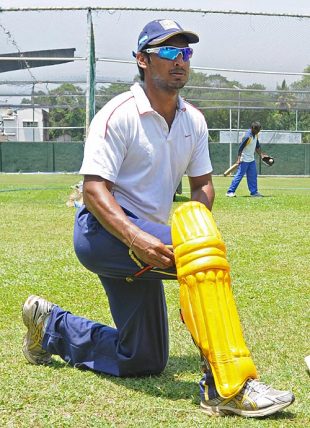
kumar Sangakkara, the Sri Lankan captain, believes his team is now mentally prepared to return to international cricket following the Lahore bus attack on March 3, but admitted that some apprehensions still remain, as shown by the recent decision to withdraw - along with Muttiah Muralitharan and manager Brendon Kuruppu - from a speaking engagement in Oxford due to security fears.

"Returning to cricket is the sign of normalcy for us, getting back to our normal lives," Sangakkara told Cricinfo. "The guys have moved on very well from Lahore. It is great to be back playing cricket and hope we can make a challenge in the World Twenty20. The side is really looking forward to doing well."

Sangakkara was one of the seven players injured in the attacks after terrorists fired and hurled grenades at the Sri Lankan team bus as it made its way to the Gadaffi Stadium on the third day of the second Test against Pakistan.

The team had its first practice nets at Lord's on Saturday afternoon and the players seemed happy to be back in action. "We remember the Lahore attack. There is a lot of emotion tied up with it, but we've got to move on," Sangakkara said. "Life moves on, cricket goes on. The guys have realised that and they are prepared mentally now."

Even if Sangakkara was happy with the security arrangements put in place by the ICC for the event, the aftermath of Sri Lanka's victory over the Liberation Tigers of Tamil Eelam (LTTE) - which brought to an end to a 26-year-old civil war - has brought with it new concerns.

Sangakkara said they had been alerted to the perceived security risks and players had been asked to keep the management informed of their movements. On Friday, he and Muralitharan were supposed to take part in a debate organised by the Oxford University Union but the visit was cancelled at the last minute as the organisers failed to put the required security arrangements in place.

"Our movements are a bit restricted at the moment but the security people have allowed us to keep our focus on the game," Sangakkara said.

Asked what the mood was like before the team boarded the bus for the first time after Lahore, Sangakkara said it was full of optimism and the usual banter. "Getting back together, going on a bus you know sometimes you look around and you feel how vulnerable you are in the bus if anyone wants to do any harm. At the same time it is great to get back on it as a team and play your first major tournament after Lahore. That feeling of togetherness, being through tough situations, and playing the game we love brings us a lot closer together."

Cricketers love routines and are superstitious when it comes to matters such as sitting on a particular seat. The Sri Lankans are no different. "Everyone just fell into their places. Lots of players have seats they are really fond of: Sanath [Jayasuriya] always sits on the right three to four rows from the front and Mahela [Jayawardene] likes to sit at the back. So the guys are back in their usual positions. Life is back to normal."


Lots of players have seats they are really fond of: Sanath [Jayasuriya] always sits on the right three to four rows from the front and Mahela [Jayawardene] likes to sit at the back. So the guys are back in their usual positions


Quite a few of the players, including Sangakkara, Muralitharan, Jayawardene, Jayasuriya, Tillakaratne Dilshan, Lasith Malinga and Farveez Maharoof played during the IPL in South Africa and are expected to carry the momentum into England. "We are trying to play on our unpredictability and our unorthodox make-up and hopefully be able to come up with the unexpected and surprising," Sangakkara said.

Unlike teams like India and Pakistan, who have landed relatively easy groups, Sri Lanka are paired with Australia and West Indies. Sangakkara is aware of the threat but is confident his team can make the second round as long as the batsmen can construct formidable scores for his in-form bowlers to defend.

"We start off in a very tough group so we need to win at least one, if not both of our opening games," he said. "We have got probably one of the best bowling attacks, but we've just got to make sure our batting complements that and gets totals we can defend. Guys like Jayasuriya, Dilshan and Mahela are in good form and can win games on their own, so it is going to be a good experience. It is also a good way to judge how far we need to go before becoming a force in Twenty20 cricket. We've got the depth in both bowling and batting."

Sangakkara has also put the onus on his young allrounders Maharoof and Angelo Mathews to perform and make an impact in the lower-middle order, which Sangakkara feels is the team's Achilles heel. "Angelo Mathews and Farveez Maharoof will have to take that responsibility of making that difference," he said. "We have lot more strengths than weaknesses."

Smith aims to overcome World Cup hurdle


South African sports fans are spoilt for choice at the moment. No sooner has the IPL finished than the British and Irish Lions have started their tour and now their cricket team is in England preparing for the ICC World Twenty20. Such is South Africa's passion for rugby the progress of Graeme Smith's side over the next three weeks may struggle to grab the attention. But they have the chance to cap off a period where they have caused some significant shifts in the world order.

They are now the No. 1 team in one-day cricket after taking that crown off Australia and also pushed them close for the top spot in Tests. With a host of their players having experienced the IPL first hand, they are primed to challenge in the ICC World Twenty20. But South Africa have a history of stalling on the big stage. Their continued success over the last year has helped loosen the chokers tag, yet it will linger until they conquer their World Cup problems.

"It would be lovely if we could be successful in this tournament or any ICC tournament that is coming up," Smith said. "We have had an incredible period in the last 16 months and the team has achieved so much. The confidence is good and we are excited about playing this tournament with the chance to go out and express ourselves. I think there is a lot more talent, flair and confidence among this team than ever before."

South Africa's preparations didn't get off to the best start when they arrived at Southgate, in north London, only to find they were not expected for a training session and had to relocate to Lord's. Smith said he would raise a few issues with the technical committee, but added that the way the team responded shows how focussed they are. "Even today with the not-so-great training facilities we have had all over the place the guys have still applied themselves. There's a good, mature attitude among the squad."

And Smith hopes the IPL experience will benefit his team, especially as a number of players were senior figures with their franchises. "A lot of our players had prominent roles in a number of the teams, which probably wouldn't have happened if it had been in India, and they had good leadership roles among their teams."

During the first World Twenty20 two years ago, in South Africa, one of the most controversial selections by the hosts was to omit allrounder Jacques Kallis. This year he is part of the squad and comes off the back of a useful spell at the IPL where he made 361 runs at 27.76 for Royal Challengers Bangalore.

"Jacques is the one player who arrives here with a point to prove," Smith said. "He had a decent performance in the IPL so is confidence his high and tactically how we use him is important. He's an allrounder and needs to contribute in all forms."

However, Smith himself didn't enjoy as productive a tournament managing 212 runs at 19.27 in his 12 matches for Rajasthan Royals. But he has masses of Twenty20 experience to fall back on including captaining Somerset to the English Twenty20 Cup title in 2005, winning the Pro20 with the Cape Cobras and last year's success with Rajasthan in the inaugural IPL.

"I have a few really good ideas on how to play the game," he said. "The experience as captain plays a key role and I think I have a good grip on the game."

This tournament is the final point in a marathon spell of cricket for the team which has included last year's trips to India and England, back-to-back series against Australia, plus six weeks at the IPL for many of its players, and Smith has called for one last effort from his squad.

"It's been a lengthy period and mental fatigue is probably our biggest challenge and something we have addressed as a team," he said. "Something that we've been really good on is responsibility and professionalism throughout this period. At different times you feel a little jaded, but I think we can find it within us to pick ourselves up for three more weeks."

'I've loved every minute of it'


It's been more than 48 hours since the Mumbai Indians lost to Shane Warne's Rajasthan Royals in Durban. Standing on the metal steps that lead up to the press-conference area at St George's Park in Port Elizabeth, Sachin Tendulkar is looking somewhere far away. His team have been all but eliminated from semi-final contention after a loss to the Chennai Super Kings, but it's the one that got away at Kingsmead that continues to haunt Tendulkar. "There's no way you should lose a game when you need just six to win with nine balls to go," he says, voice shot through with disbelief.

"We lost to the Kings XI by two runs as well. I can understand a team being bowled out for 85 when chasing 120, but to bat through the overs and not get the runs... that's inexcusable."

Like most of the greats, Tendulkar hates losing. And as the security guard watches nervously, he talks to me with an earnestness that is almost vehement. There's a perception that many players are on the IPL gravy train for the big-fat pay cheque; players who "shouldn't be here", as Ray Jennings put it in his wonderfully candid way. Tendulkar is not one of them. Some players prefer to walk out to Kylie Minogue's music. In his present mood, you sense that Tendulkar would opt for REM's "Everybody Hurts".

For Tendulkar, like for Glenn McGrath, who spent the entire second season of the IPL on the bench, winning is pretty much everything. This is, after all, the man who once admitted that he found it tough to let his son win when they played with a little bat and ball.

A week after our meeting in windy Port Elizabeth, I see him again. The mood isn't any better. Mumbai have been thrashed by Delhi Daredevils. A campaign that started promisingly with victory in the opening game at Newlands against the fancied Chennai lies in tatters. Five wins and eight defeats, seventh on the table.

At the press conference he bites down on some words, tries hard not to point fingers. But his disappointment is an open wound. Here for the money? You must be joking. As he prepares to leave the stadium and the 40-minute drive from Centurion to the team hotel in Sandton, we arrange to talk. Over the phone. I still have another game to watch, and Manish Pandey, a 19-year-old with a baby face, pounds out a heady century.

I slip unnoticed into the press-conference room and dial the number. It makes sense to ask Tendulkar about the IPL experience. After all, most of the South African contingent has grilled him about the way their nation has embraced the tournament. And when we first chatted, a fortnight into the competition, he had mentioned just how much of a strain the interminable travel was. "It's been very good but it was tough as well, especially to lose so many close games," he says after a small pause. "We should have won them, but we just didn't finish the job.


"That was a decision I took two years ago, not to play Twenty20 cricket for India. I felt my body was struggling and I wasn't able to give 100%. I didn't want to be a burden on the team. If you have one loose link, it's unfair on the other guys"


"Also, playing away from home has been different. People back home, not just in Mumbai but right across India, had been looking forward to this IPL season. That it didn't happen at home must have been hard on them. It's always different when you can't watch it live. The home games are very big back home. The atmosphere is something else. And you get pretty much everyone backing the home team. But I sort of knew that people would turn up and appreciate good cricket in South Africa. The crowds have been fantastic."

Given how well some of the senior players have done in the IPL, it's hardly surprising that there has been innuendo about how useful their experience would be in English conditions. But Tendulkar himself has no regrets about missing out on the World Twenty20. Sure, he'll be at some of the games, but he'll also be at Wimbledon, enjoying some time away from the spotlight that has been his lot for two decades now.

"That was a decision I took two years ago, not to play Twenty20 cricket for India," he says. "I felt my body was struggling and I wasn't able to give 100%. I didn't want to be a burden on the team. If you have one loose link, it's unfair on the other guys.

"The team did well, more than well, in South Africa [2007]. It's a settled side now. I felt I should not disturb the combination. One-day cricket and Test cricket are different, because I've been part of the team for so long. But if I was to force myself into the Twenty20 team, it would mean a reshuffle that I don't want."

Even after such a gruelling IPL season - each of India's 15-man squad played a part - he remains confident that MS Dhoni's team can retain the trophy they won in improbable circumstances in the Highveld two years ago. "I think we've definitely got a tournament-winning squad," he says. "It looks fantastic, in all respects. The batting, bowling and fielding are equally strong, and the morale is very high."

Along with the seniors' debate, there have been young players catching the eye. Before Pandey's brilliant innings, there was Sudeep Tyagi with his seam bowling, and Pragyan Ojha with his left-arm spin. But when you ask Tendulkar about the young players that he has watched in the tournament, and their long-term potential, he shies away from judgments. "I don't think this is the right format to judge a player," he says. "One-day cricket or Tests reveal far more about a player's ability. With Twenty20 you can sometimes have days when everything you try just comes off."


His own career has revived spectacularly after the struggles with injury. There were two Test centuries in Australia, and though he failed in Sri Lanka, centuries in Chennai and Hamilton played a huge part in series victories over England and New Zealand. There were also two magnificent innings in the CB Series finals against Australia in March 2008, when he rewound the clock to Desert Storm times and single-handedly tilted games India's way.

A few more straight-drives and paddle sweeps and he'll have 30,000 runs in international cricket. Barring Don Bradman's, which acquire a near-mythical status as the years pass, Tendulkar owns practically every batting record in the game. What makes the man tick, what makes him get out of bed every morning and choose the less-than-easy option?

"I enjoy playing cricket," he says with a laugh. "It's the simplest answer and the one people seem to find hardest to believe. I love being out there. I have a lot of fun. There are always various challenges to occupy you, and also the pride that comes with playing for India. That's still a huge thing, because it's all I ever wanted as a child. I don't think my feelings are any less strong now."

Ever since he was a teenager scoring hundreds for fun in Mumbai, it's his sense of calm that has set him apart. Few events have shaken that composure down the years, and none quite like the terror attacks in Mumbai last November. The siege at the Taj Mahal Hotel took place just around the corner from his restaurant, with its cricket-themed walls and personally chosen menu.

"That was a tragic experience," he says after a long pause. "I don't think anyone expected that something of that nature could happen. It was just terrible. I dedicated the victory against England [Chennai] to the victims and their families, because I felt it was the least we could do. Winning a cricket match was not going to make people forget what had happened to them, but if they smiled even for a second, we had been able to do something. It was only about diverting minds, however briefly. It was a huge loss for everyone, and not something that can ever be measured in terms of wins and losses."

In that context, was that century the one he cherishes most? "Definitely," he says. "The mood of the entire nation was so low. And on that last day, we finished so strongly. It was my most important hundred."


"Right now, things have been going well. I want to focus on the next engagement. Winning the World Cup is the ambition of every cricketer. I'm not alone in that. But it would be special


In his wonderful biography of Sunil Gavaskar, the late Dom Moraes titled one chapter "The Halcyon Years". These are such days for Tendulkar, for whom the finish line is in sight. But even as he approaches it, he's enjoying every moment of being part of a side that appears equipped to take on all-comers, home and away. Having spent much of his career as part of a team that struggled, especially away from home, what does it now feel like to be senior statesman and a member of a side that's challenging for top honours in every form of the game?

"It's terrific," he says, the mood lifting. "I find it a real pleasure to be part of this team. We've got the quality to compete with the best, and it's exciting when you do so well." The emphasis is on enjoying the moment, rather than worrying about which boxes still remain to be ticked. "I don't look to set targets, honestly," he says. "I play as hard as possible, and when things happen it's a great feeling. I don't disclose targets. But for example, it's nice when you go to Australia and do well there."

For most people connected with Indian cricket, though, the World Cup remains a Holy Grail. Tendulkar, who grew up watching the Kapil Dev generation, has mixed memories of both 1996 and 2003, when mountains of runs off his own bat weren't enough to cover for inadequacies elsewhere. And he insists that he won't put pressure on himself by over-egging the World-Cup pudding. "I don't want to look that far ahead," he says. "Right now, things have been going well. I want to focus on the next engagement. Winning the World Cup is the ambition of every cricketer. I'm not alone in that. But it would be special."

His children, Sara and Arjun, are now old enough to nurture ambitions of their own, and the time spent away from them is accepted with something approaching resignation. "I guess you have no choice," he says of the touring life. "When the children grow up, they'll know why their father was away for so long. And hopefully, they'll be proud of me and what I did."

For 20 years now the team has been his surrogate family, and there have been those that have left a deeper impression than others. "There have been many that I've shared the Indian dressing room with, but I'd make special mention of Sunil Gavaskar and Ravi Shastri," he says when asked about those who helped shape him. "My coach, Ramakant Achrekar, my brother Ajit, and my father were the others that have given me the most."

On the field, not much has changed. Abdul Qadir once mentioned milk, before he was smashed for sixes in Peshawar, and there was the uncomfortable task of testifying in the Harbhajan Singh "racism inquiry" not so long ago. Banter has been part of the game ever since the good Doctor Grace told a bowler that the crowds had come to watch him bat, and not to see him bowl. Tendulkar wouldn't have it any other way. "I'd like to think that I've been friendly with everyone," he says. "Whatever happens is only on the field and you don't need to get too personal. I don't expect friendship out there. They are competing as hard as you are, and looking to win against you. As long as you bear no grudges, I have no problems."

Jack Fingleton immortalised Victor Trumper with Never Another Like Victor. The Archie Jackson story lives on through the words of David Frith. In Tendulkar's case words aren't even necessary. There are so many thousands of hours of archival footage, and even those born years after Waqar Younis bloodied his nose on debut have watched his finest hours on youtube and commemorative DVDs. But what if it was possible for him to choose how he's remembered after leaving the game? He thinks for a while. "As somebody who enjoyed the game as much as he could," he says. "I've played fair and hard and loved every minute of it. That would be the best way to be remembered. And also as a team man. While you're achieving team goals, your own milestones will pass by."

Gayle must walk the talk


Chris Gayle, the West Indies captain, has made no secret of his enjoyment of Twenty20. In his own words, it "wouldn't be so sad" if Test cricket gave way to the 20-over version and he was considering giving up the longer formats to focus on Twenty20. The way his men played in the Tests and ODIs in England it looked as though he wasn't the only one whose attention span was suited to three-hour games. Expectations will therefore be raised that West Indies can lift for the World Twenty20.

They are in a difficult group along with Australia and Sri Lanka - it's the only group that doesn't feature an Associate side - and therefore they must hit top form from day one. They beat Australia the only time the teams have met in a Twenty20 and they have never faced Sri Lanka.

West Indies have the quite remarkable record of having tied two of their 11 Twenty20 internationals - both against New Zealand - and they have won four and lost five. At the 2007 World Twenty20 they went down to both South Africa and Bangladesh in the group stage and were bundled out in the space of three days.

Strengths

A batting line-up boasting Gayle, Xavier Marshall, Ramnaresh Sarwan, Andre Fletcher, Denesh Ramdin, Dwayne Bravo and Kieron Pollard should score its runs quickly. They are all capable of demolishing an attack with clean strikes and opposition bowlers must keep the wickets falling to stop West Indies posting a big score. Throw in Shivnarine Chanderpaul as the man who can anchor one end should wickets tumble and it's a batting order with the potential to scare any bowling group.

Weaknesses

Those who live by the sword die by the sword. West Indies' batsmen can be destructive but they can be just as liable to capitulate dramatically. And it's impossible to predict which version of the side will arrive on any given day. At their best Fidel Edwards and Jerome Taylor are fine fast bowlers but opposition batsmen's eyes will light up when they see the backup brigade of Lionel Baker, Dwayne Bravo and Darren Sammy.

X-factor

The X-man is the X-factor. Nobody highlights the disparity between potential and consistent performance in West Indies' squad quite like Xavier Marshall. Never one to back down, he has the ability to dominate even the best attacks, as he proved when Australia visited the Caribbean last year. His 36 off 15 balls in the Twenty20 in Barbados set up West Indies' victory over Ricky Ponting's men. Far too many failures fill the gaps between his triumphs but even one matchwinning effort in this tournament will justify his place.

Key players

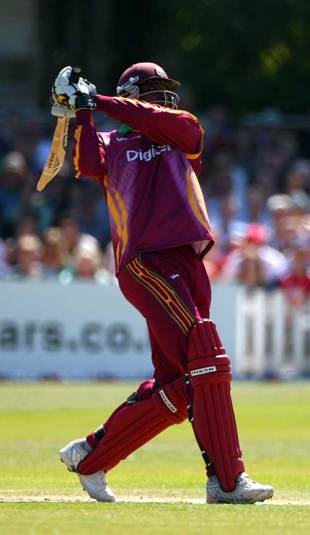
Gayle is the only man to have scored a century in a Twenty20 international and it came at the previous World Twenty20. Having shown little interest in the Test series in England, he has no excuse now that his preferred format is taking centre stage. At his best, he can win a game in a handful of overs. The question is, after such a lean patch in England, can he reach his best?

Twenty20 form guide

Over the past 12 months, West Indies have won two Twenty20s, lost one and tied one. Importantly, they beat Australia - who they meet in the group stage - in Barbados last year. But their matches have been infrequent and it's impossible to ignore their failure to win a Test or ODI in England this year - much of the personnel remains the same from those longer formats.

Squad: Chris Gayle (capt), Denesh Ramdin, Lionel Baker, Sulieman Benn, David Bernard, Dwayne Bravo, Shivnarine Chanderpaul, Fidel Edwards, Andre Fletcher, Xavier Marshall, Kieron Pollard, Darren Sammy, Ramnaresh Sarwan, Lendl Simmons, Jerome Taylor.

All eyes on New Zealand's new crop


First, the good news. The shorter the format the more competitive New Zealand become. Despite slumping to eighth on the Test rankings they have been World Cup semi-finalists in two of the past three tournaments and matched that achievement at the inaugural World Twenty20, where they were denied a place in the decider by Pakistan.

Now the bad news. Their leading performers two years ago included Craig McMillan, Shane Bond and Mark Gillespie, none of whom are there this time around. But there is an upside: since 2007 they have added a couple of more than handy names to their team with Jesse Ryder and Martin Guptill proving dangerous at international level.

And the other plus is that New Zealand have found themselves in a group with Scotland, meaning along with South Africa they should have no trouble progressing past the opening stage. Then things become less clear-cut. Will a few powerful hitters and an economical A-grade slow-bowler be enough for them to move past more imposing line-ups? Only time will tell. But it's a fool who writes off New Zealand when the 50- or 20-over tournaments arrive.

Strengths

Crafty, high-quality spin is a major weapon in Twenty20 and slow bowlers don't come any cannier than Daniel Vettori. New Zealand can all but guarantee that he will deliver four thrifty overs each match; he has done that in every one of his 14 Twenty20 internationals and the most he has ever gone for is 6.75 an over. Of men who have played ten Twenty20s for their country, only Umar Gul has a better economy rate than Vettori's 5.35.

Weaknesses

While Vettori contains at one end, the fast men will be required to keep things tight at the other. And that is New Zealand's biggest challenge. Bond, Gillespie and Chris Martin did adequately in 2007 but none is in this squad. A pace attack based around the likes of Kyle Mills, Iain O'Brien, James Franklin, Ian Butler and Jacob Oram won't strike fear into many Twenty20 batting line-ups. To compensate for a lack of firepower they'll need to bowl smart - changes of pace, yorkers, cutters - or else risk an early exit.

X-factor

According to the online Wiktionary, an x-factor is that which has "unknown or unforeseeable consequences". That's pretty much how New Zealand Cricket would define Jesse Ryder. Despite having had behavioural issues in the past and being one of the big flops of the recent IPL, Ryder hasn't often let his country down with the bat. A Twenty20 strike-rate of 137.61 shows his power and if he and the equally dangerous Brendon McCullum can get their side off to a couple of quick starts, it could be the difference between an early departure and a place in the finals.

Key players

Vettori is the most important with the ball, Ryder and McCullum could destroy attacks and Oram has the ability to finish an innings in style. But it's hard to argue that any of those men are more important to New Zealand's chances than Ross Taylor. No. 4 is a key position in Twenty20. If the openers have failed he must be steady without stalling; if they have thrived he needs to maintain or increase the momentum immediately. Taylor has the game to fill that role. He had a good IPL and his barely believable 81 off 33 balls against Kolkata Knight Riders was a highlight.

Twenty20 form guide

Warm-up wins against Bangladesh and Ireland don't reveal much, although the form of Taylor and Guptill in those games was a pleasing sign. More of a positive was New Zealand winning their two most recent Twenty20s, against the reigning champions India in February. Since then it has been an up-and-down time for their squad members. Taylor thrived at Royal Challengers Bangalore, McCullum played a couple of strong innings as captain of Kolkata Knight Riders but was in the firing line as his team failed, while Ryder, Oram and Scott Styris had largely forgettable tournaments. In the meantime, Franklin has enjoyed a productive stint with Gloucestershire and O'Brien has been acclimatising with Leicestershire.

Squad: Daniel Vettori (capt), Neil Broom, Ian Butler, Brendon Diamanti, James Franklin, Martin Guptill, Brendon McCullum (wk), Nathan McCullum, Peter McGlashan (wk), Kyle Mills, Iain O'Brien, Jacob Oram, Jesse Ryder, Scott Styris, Ross Taylor.

Australia warm up with easy win


Australia, spurred to a daunting total by a thumping opening partnership, clinched a facile victory over Bangladesh in Nottingham. From the start it was apparent that Australia were going to dominate, what with Bangladesh's medium-pacers leaking runs and Tamim Iqbal reprieving Brad Haddin in the first over. Haddin and Shane Watson - who slammed a 21-ball half-century - made Bangladesh pay and though Mahmuddulah's four wickets ensured Australia didn't post a mammoth total, the favourites clearly had enough runs. Bangladesh's top order chased hard, but following Shakib Al Hasan's dismissal for a sprightly 54 in the 14th over the wheels fell off.

Australia's openers effectively nailed the match in eight overs. When the ball was new, the field in and the wicketkeeper up, both Haddin and Watson boldly chose to go over the top, twice lofting Syed Rasel over the onside for sixes in an over. Then, when the field spread out, the pair chipped and nudged it cleverly into the gaps to keep the board ticking over constantly, but also managed to find the fence whenever the bowlers dropped it short and wide.

The fourth over went for 16, with Haddin and Watson each slamming sixes, and the fifth cost 22. By this time Watson and Haddin both were using their feet and wrists excellently. Watson dumped offspinner Naeem Islam for four and six in consecutive deliveries as Australia reached 86 in seven overs. Watson raised his half-century in just 21 balls with another swipe over midwicket, the most profitable shot on this track.

Mahmudullah struck in a double-wicket over during which both openers picked out fielders in the deep. Enter Andrew Symonds and three sixes over midwicket, but after racing to 27 from 14 balls, he fell to Mahmudullah in the 13th over. Three deliveries later Mahmudullah ended Ricky Ponting's scratchy innings and Australia had a new pair at the crease again. Where his team-mates all suffered, Mahmudullah returned figures of 4 for 37 and his role was instrumental in roping Australia in from what seemed a massive total.

There was the usual flurry of heaves, hoicks and wickets during the final overs as Bangladesh snapped a 52-run stand between Michael Hussey and Michael Clarke and finished with a tidy last three overs.

Bangladesh began their chase frenetically, taking 31 from the first two overs. In the first over Tamim larruped Nathan Bracken for 18, using his feet to launch a beautiful straight six. In the second over Junaid Siddique took Brett Lee for three boundaries, the most audacious being a swat over extra cover with Siddique a third down the track.

Mitchell Johnson sent Siddique's leg stump cartwheeling with a quick and straight delivery and Lee had his man when Tamim drove straight to mid-off in the fourth over. Then came an engrossing period where both sides battled for leverage. Mohammad Ashraful broke the shackles of a nervous start with three successive fours off Johnson, using his crease excellently to clear the infield on both sides. Bracken swung it back with three singles in the sixth over, but Shakib and Ashraful took boundaries off David Hussey; Tamim's sweep was forceful while Ashraful's reverse-paddle was gentle.

In the next over Tamim paddled and drove James Hopes for boundaries and Ashraful sliced to third man. Following Ashraful's dismissal for 26 to the first ball of Johnson's next spell, Shakib clubbed Symonds' first two deliveries for six, survived a stumping, and promptly creamed four through extra cover. His half-century needed just 25 deliveries.

Shakib was the fourth to go and at the time Bangladesh were still in the hunt, but his dismissal was a hammer blow and the innings never recovered as Lee and Bracken strangled the life out of the lower order.

Thursday, May 14, 2009

Cricket to be part of 2010 Asian Games

Cricket has become an Asian Games sport after it was approved by the Olympic Council of Asia (OCA) on Wednesday. It will make its debut in Guangzhou in 2010 with India and Pakistan pledging to send their best available teams.

The format of the game will be Twenty20, with both men's and women's competitions. India, Pakistan, Sri Lanka and Bangladesh will qualify automatically, along with host nation China. Other countries will have to play a qualifying round to fill three additional spots.

"India and Pakistan were the drivers," OCA president Sheikh Ahmad Al-Sabah said. "Pakistan and India will come with their best teams because it will be a big competition. Asia's four Test-playing nations have committed to sending their best available teams."

The 2010 Asian Games will take place between November 12 and 27 in Guangzhou. Cricket was last played at a major multi-sport event in 1998 during the Commonwealth Games in Kuala Lumpur.

Madan Lal applies for ICL release

Madan Lal, the former India allrounder and coach, has applied for a release from the ICL in what is the first officially known response from the unauthorised league's players and support staff to the BCCI's recent amnesty offer. Lal, who was coach of ICL's Delhi Giants, said he expected more cricketers and some support staff to follow suit and hoped the BCCI would utilise his services appropriately.

"I have applied for a release from the ICL contract," Lal told Cricinfo. "I am thankful to the BCCI for allowing an opportunity for those with the ICL to return to the official fold. I have coached various Indian teams at different levels before and I hope the BCCI will utilise my services and experience in the best manner possible."

Lal's request followed an ICL communication to its players and support staff last week to send in their requests for a release, if needed, before May 15. The ICL will then hold a management meeting, possibly on May 18, to decide on these requests and the future course of action.

Sandeep Patil, Balwinder Sandhu and Karsan Ghavri, three former India players, and Ajit Wadekar, a former India captain, had approached the ICL for a release before the BCCI's offer because of a "lack of adequate cricket".

"Days before the BCCI decision, three of us coaches - Sandeep Patil, Balwinder Singh Sandhu (Dhaka Warriors coach) and myself - had a meeting with Himanshu Mody [ICL business head] and Kiran More [ICL board member]," Ghavri told Cricinfo. "We told them about our issues including no cricket being played from November 2007 and also about the salaries not being paid after that. Keeping in the prevailing conditions, we asked them to release us. We then got a call saying we were free to leave and would get our release letter by May 20. On April 30, Ajit Wadekar and I submitted the application for a release."

Patil, who had coached ICL's Mumbai Champs, had stood down from active duty by the end of the last season due to "personal reasons". "At the meeting with the ICL, they gave the coaches the option to continue or step down," Patil told Cricinfo. "In any case I had resigned even before the BCCI decision to grant amnesty to the ICL players, coaches and backroom staff. I have no complaints and no regrets."

ICL officials, however, refused to confirm whether they had received any official requests from players or support staff for a release. "We remain confident about our future plans, especially the October programme," an official said. The ICL had cancelled its March tournament due to the deepening economic recession and the non-availability of Lahore Badshahs, the Pakistan team, due to cross-border political tensions following the Mumbai attacks.

"I have had an excellent relationship with the ICL over the last two years and I have no complaints at all about that association," Lal, a member of the 1983 World Cup-winning squad, said. "But now I feel it's the right time to move on professionally. There are many other ICL players and support staff who think similarly." Apart from his ICL commitments, Lal runs a coaching academy in Delhi and has a media contract with a television channel.

The BCCI had announced on April 30 that ICL players and support staff who wished to return to the official fold should do so by May 31. These players would be immediately allowed to play domestic cricket, including the IPL, and will become eligible for international cricket after a 'cooling period' of one year. Significantly, the ICC's new rules for official and unofficial cricket, which aims to plug existing loopholes, will come into force from June 1.

BCCI officials were not available for comment but it's understood that the board has written to various state associations to confirm the amnesty offer and stipulate the norms that needed to be followed while readmitting such players. "We have been told that we would either have to produce an NOC from ICL or hand over a copy of the contract termination letter that has been sent by us to ICL," a senior ICL player told Cricinfo. "We might then have to sign an official undertaking with the BCCI, which would bar us from participating in leagues or tournaments not authorised by the Indian board."

Ponting expects Vaughan to return

Australia's captain, Ricky Ponting, believes that England's Ashes veterans, Michael Vaughan and Steve Harmison, will be back to face his team come the start of the series, despite the instant impact that Ravi Bopara and Graham Onions have made since they came into the side for the Lord's Test last week.

Neither Vaughan nor Harmison is in the set-up for the second Test against West Indies, starting at Chester-le-Street on Thursday, and with no more five-day cricket before Australia arrive at Cardiff on July 8, time is running out for them to prove their worth.

But Ponting, speaking to Fox Sports, said: "I've just got a bit of a feeling that they might want to get Vaughan back into the set-up and they might pick Harmison for when we get there. So I think their side might actually shape up closer to the side of 2005 or 2007 than we actually think it might."

Vaughan's No. 3 slot is currently occupied by Bopara, whose 143 in the first Test was the decisive innings of the match. "Bopara made a really good hundred against the West Indies last week, but their batting is fairly similar with Pietersen, Collingwood, Strauss, Cook, those guys," he said. "We've played a lot against those guys over the years, so it's not too dissimilar, both sides have probably got three or four changes from last time we met."

As for Onions, who took 5 for 38 at Lord's, Ponting remained to be convinced of his long-term role. "He's a lively bowler, and he did well in that game but I'm not sure when they get the Sidebottoms and all those guys back if he'll still be in their side, but we'll wait and see."

Asked about Vaughan's prospects of an Ashes recall, England's captain Andrew Strauss responded: "There's a chance, there's definitely a chance. "There's a lot of cricket to be played between now and the Ashes, and we all know what Vaughany brings in terms of runs and experience. But the ball is in the hands of the players who are in the side right at the moment." 

No referrals for Ashes series

This summer's Ashes series will be one of the last in which the umpire's decision is final, after the ICC confirmed that its controversial Umpire Decision Review System (UDRS) is set to be introduced permanently into the game on the basis of a "phased roll-out" from October 2009.

The ICC chief executive, Haroon Lorgat, confirmed the plans at a press conference at Lord's, following a two-day meeting in which the results of nine months' worth of trials were assessed by the ICC's cricket committee.

A final decision on whether the new system will become a permanent feature of Test cricket will be taken by the ICC's chief executives committee and their main board, whose next meetings are due to take place during their annual conference at Lord's from June 22-26.

"I'm excited that the committee concluded the umpire decision review system had a positive effect on the game," said Lorgat. "It reduced the number of incorrect decisions and also cut down on instances of player dissent.

"We will seek [provided the ICC chief executives and board agree] to roll out the system from October 2009. The time ahead of that date will allow us to firm up the playing conditions, technical specifications and protocols, ensure additional training for match officials and further brief the players so that the process can be successfully implemented."

Though designed to reduce controversy, the new system - which gives players the opportunity to request a review by the third umpire of a decision made by the on-field umpire they believed was wrong - has so far muddied the waters in several instances, not least during the Jamaica Test between England and West Indies in February.

"The protocols were clear, maybe the application was not so good," said Lorgat. "It's the really bad errors we want to eliminate. We had a fair amount of feedback from players and most of it was positive. They accept the fundamental thing that we want to get decisions right."

The cricket committee, chaired by the former West Indies captain Clive Lloyd, said it believed the new system, for all its faults, would reduce instances of bad decisions.

The committee also looked into the possibility of playing day/night Test cricket, and staging a trial five-day game under lights in 2010. But first they said more research was needed on finding a suitable ball, with the standard red one unsuitable for floodlit cricket, while Lloyd pointed out the effect of early evening dew would also have to be considered. Trials with light green and pink balls are currently taking place.

The committee also said there was no need to alter the present format of 50-overs international cricket, amid concerns the format was becoming jaded in the Twenty20 era, and that there was not a need to impose weight restrictions on bats

It also said it had no problems with double-sided bats and confirmed that the switch-hit, as pioneered by Kevin Pietersen, should remain legal.

The committee also called for stricter enforcement of rules on over-rates, and the doubling of fines for slow play, so as to cut down time-wasting by both batting and bowling sides. Lorgat said it was vital Test match over-rates were maintained or improved so the five-day game could continue to "engage" with spectators. 

Tait overlooked for Australia contract

Shaun Tait has missed a spot in Australia's 25-man contract list, but Andrew Symonds has made it along with six players who gained full deals for the first time. In a couple of pointers towards the Ashes, South Australia's Graham Manou is the back-up wicketkeeper behind Brad Haddin and Nathan Hauritz is the only specialist spinner, dramatically increasing his prospects of winning a spot ahead of Bryce McGain.

The squad is full of fresh faces following Australia's season of change in 2008-09, with Manou joined by Callum Ferguson, Phillip Hughes, Marcus North, Andrew McDonald and Peter Siddle. Tait was cut in a surprise decision, particularly after Cricket Australia did not provide a medical clearance for him to play in the IPL.

Andrew Hilditch and his fellow selectors must now see Tait, who has regularly suffered from injury during a hit-and-miss career, as a Twenty20 specialist, which reduces his ranking among the elite group. David Warner, another short-form player, was overlooked despite regular limited-overs outings since January.

Adam Voges missed out two months after choosing to get married instead of appear in the one-day series in South Africa while the exits of Phil Jaques, Ashley Noffke and Beau Casson were predicted following interrupted seasons. However, Dave Gilbert, the Cricket New South Wales chief executive, was upset by the omission of Jaques.

"His last Test innings for Australia was a century and he averages in the high 40s," Gilbert said. "How he is not considered in the top 25 cricketers in the country is hard to comprehend."

Brad Hodge, a perennial reserve, held his place along with Cameron White, who was not chosen for the series against Pakistan in the United Arab Emirates. Symonds, Brett Lee and Stuart Clark, who have also battled injuries, were retained.

Hilditch's next task is to pick the Ashes squad, which will be named on Wednesday, and Manou received a timely boost. "No one can doubt Manou's credentials following his performance in state cricket over the last two seasons, in all forms of the game," Hilditch said. He said the squad was also picked with an eye to the 2011 World Cup.

"It's obviously a very exciting time for players receiving their first contract, such as Phillip Hughes, who has had an outstanding start for Australia and will have an important role in the team's future," Hilditch said. "Siddle has had an outstanding debut season and richly deserves his contract.

"McDonald, North and Hauritz have been rewarded for their performances in South Africa and Nathan had an excellent one-day tournament against Pakistan recently. Ferguson has had an impressive debut in one-day cricket and will be an important part of our future in that form of the game."

Australia are scheduled to play 14 Tests over the next 12 months, with each player receiving A$13,000 per appearance, and up to 34 one-day internationals. ODI match fees are set at $5200 while they get $3900 for a Twenty20.

Last summer the contract list ballooned following the addition of 11 players during the year, which also included the retirements of Matthew Hayden and Stuart MacGill. The top tier of stars had a base deal of more than $1million in 2008-09 and the bottom level began at $180,000.

The final amounts of the new pay packets will be finalised when Cricket Australia's ongoing negotiations with the Australian Cricketers' Association conclude. Those discussions and the timing of the limited-overs series with Pakistan delayed the contract announcement by two weeks.

2009-10 contract holders Doug Bollinger (NSW), Nathan Bracken (NSW), Stuart Clark (NSW), Michael Clarke (NSW), Callum Ferguson (SA), Brad Haddin (NSW), Nathan Hauritz (NSW), Ben Hilfenhaus (Tas), Brad Hodge (Vic), James Hopes (Qld), Phillip Hughes (NSW), David Hussey (Vic), Michael Hussey (WA), Mitchell Johnson (WA), Simon Katich (NSW), Brett Lee (NSW), Graham Manou (SA), Shaun Marsh (WA), Andrew McDonald (Vic), Marcus North (WA), Ricky Ponting (Tas), Peter Siddle (Vic), Andrew Symonds (Qld), Shane Watson (NSW), Cameron White (Vic). 

Amber lights at the Riverside

Although ticket sales for the opening day of the second Test have improved since yesterday's figure of 3000, Chester-le-Street won't be bursting at the seams when the action starts on Thursday. The punters are clearly beginning to pick and choose which matches they attend and, if Chris Gayle's comments are anything to go by, some players will soon be following a similar path.

His interview with a UK national newspaper has set another warning light flashing about the future and primacy of Test cricket. Although he attempted to downgrade his view that he "wouldn't be so sad" if Tests vanished in favour of Twenty20s, by saying his comments were meant from his personal point of view, it is another damaging blow for a sport that is battling to maintain a relevance.

The fact that Gayle has had to leave his IPL deal to play in cold, early-season English conditions, in a Test series shoe-horned into the calender, has clearly not gone down well, despite his latest effort to convince otherwise. "I'm happy to be here right now to try and retain the trophy," a rather weary-looking Gayle said as he responded to his comments.

He claimed the interview in The Guardian had been "misquoted and misinterpreted" which is the usual response from a sportsman who wants to back himself out of a corner. However, he didn't try to alter his comments, rather just clarify that he was talking about himself and not Test cricket as a whole.

"I don't see myself playing Tests for any long period of time, but I think Test cricket will always be there. Twenty20 has come on board and it's made a huge impact on the world, it's brilliant, games have been sold out and it has taken the place by storm. I look at Test cricket differently, I don't see it as long term for me, just for me, I'm just speaking about myself."

What should come as a concern for those running the game and trying to cram in endless international fixtures to justify television deals is Gayle's reasoning. "There's a lot of cricket being played and I've started to develop a lot of injuries," he said. "It takes a toll on your body and your mental strength so at some stage you aren't going to go on forever. You have to choose what you are going to do as a person.

"It's something I've discussed before, maybe not in the media, but I've talked to friends and players about it. It's not like I've just thought about it overnight."

However, as one of nine current Test captains in the world game, Gayle needs to remember that his role goes beyond the personal. It shouldn't just be about the here and now for him, but also the bigger picture. Not everyone is going to make it as a millionaire Twenty20 star and Gayle, as one of the most flamboyant batsman of his generation, should be able to play a role in promoting the five-day game.

Andrew Strauss is one such player who is likely to miss the Twenty20 revolution and made comments before the Lord's Test that he wouldn't allow an England player to arrive 48 hours before a match. Gayle hit back in the newspaper interview, but tried to ease any potential tensions by saying no disrespect was meant.


"There's a lot of cricket being played and I've started to develop a lot of injuries. It takes a toll on your body and your mental strength so at some stage you aren't going to go on forever. You have to choose what you are going to do as a person." Chris Gayle ponders his Test future
 

"It wasn't his concern," Gayle said. "I respect Strauss, I would never have any conflict with him. I just find it a bit strange that he touched on that sort of point and he should leave it alone. "Maybe he's under a lot of pressure. The Ashes series is huge.

"Maybe he tried to put the pressure on me to try to take a bit of pressure off him. I have respect for Strauss it's not like I'm trying to degrade him, I would never do that. Sometimes you just have to stand up for your rights."

Strauss maintained there were no tensions and suggested that any problems the West Indies captain had were not his problem, but admitted he had concerns about the health of Test cricket. "We haven't been sitting in the bar telling tales of our lives but our relationship has been pretty good. I've had no problems with him up until now. If he is uncomfortable with what's gone on in the last couple of weeks that's an issue for him rather than myself.

"It [Test cricket] is under pressure," he added. "I think it is important we play good Test cricket to make people aware of what a good format it is and how entertaining it can be. It's the only game that really tests out your temperament, your technique, your hunger, your bravery, all those aspects of the game."

That seems an opportune moment to bring this back to the actual game; a Test match, the ultimate format. West Indies' game fell away so rapidly at Lord's that it was difficult to recognise the team that fought so hard in the Caribbean. Now with Gayle's comments ringing in their ears it's hardly the motivational stand they needed from their captain. "The guys know the situation. It won't affect us, we are all big men," he said.

Strauss, however, was hoping the furore will take Gayle's mind off the serious matter in hand. "He is always dangerous. He always plays the same way, hopefully he'll be slightly distracted tomorrow."

Gayle clearly won't be playing Test cricket much longer, although he laughed off the idea that this would be his final game. He said he still had a job to do in rebuilding this West Indies side and now would be a good time to show he really means it. At the moment Gayle's opinions appear the minority view, but the game needs to work out what it wants to be in the future. If players don't want to play, and people don't want to watch, then there really is trouble ahead.

Andrew McGlashan is assistant editor of Cricinfo